When a Caller Opens With Price Inquiry
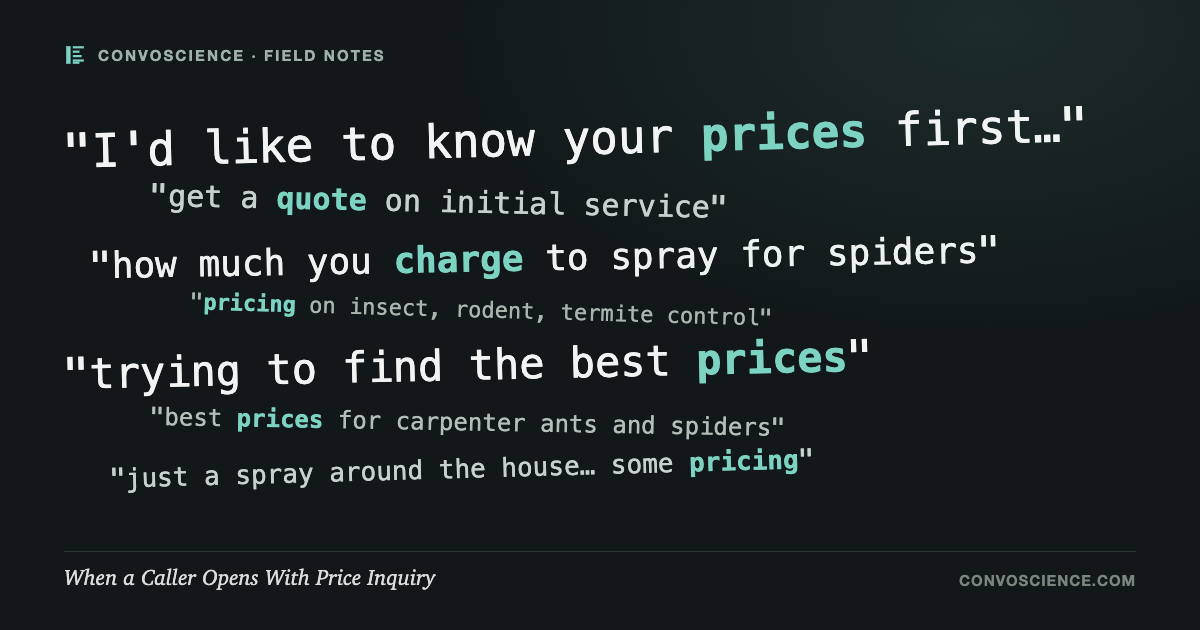
About one in ten first inbound calls to a pest control company open with the customer asking about price — a quote, an estimate, what something costs — before the agent has had any chance to hear what's actually going on. How the agent handles that moment is one of the clearest predictors of whether the call turns into a booking.
For a pest control company, the first inbound call is where a lead either becomes a customer or doesn't. There's no second first impression, and no marketing spend that makes up for a call center that fumbles the opening minutes of that conversation. Discovery — the part of the call where the agent actually learns what's going on at the customer's home — is the biggest lever we've found for whether that first call turns into a booking. We score discovery on three things:
- Shared Understanding — the agent and customer arrive at a real picture of a certain home and a particular problem, not a generic house and any pest.
- The Right to Recommend — the customer comes away treating the agent as someone who knows pests, not someone just reading a script. The agent has earned the legitimacy to recommend, not just answer questions and quote prices.
- Trust — the customer believes the agent is competent and acting in their interest, not just working a sale.
When a first inbound call hits all three, the chance of booking goes up by 25-30%. That lift is definitely worth pursuing; however, doing a good job of discovery consistently is not easy. Even under normal conditions, only about one in four calls complete all three goals — and price-first calls, the ones we opened with, are where that discovery gets hardest to pull off.
What it sounds like in real calls
These are real openings from the corpus:
"I'd like to know your prices first…"
"I was calling to get a quote on initial service."
"I'd like to know how much you charge for… to spray a home, like, for spiders."
"I'm just calling, trying to get some ballpark pricing on some of your insect, rodent, termite control services."
"I'm calling around trying to find the best prices."
"I'm calling because I'm doing some shopping around to see who has the best prices for carpenter ants and spiders."
"I was just calling to see if I can get some pricing on… general pest control… just a spray around the house… "
What makes these calls difficult
A good inbound call proceeds in a specific order: the agent figures out what's going on, diagnoses the problem, recommends the right treatment, and only then talks about price. That's consultative selling, and in pest control it's how the customer actually gets the right service.
A price-first opening, on the other hand, runs counter to this logic. The customer wants a number, not a conversation, which pushes the agent to skip discovery. Worse, it casts the agent as an order-taker reciting a menu, instead of someone whose judgment matters — so the caller makes the agent's job more difficult by throwing them off balance, unable to do their job properly.
Why customers do it
Consumers have learned to protect themselves from being sold to. Bracing for a pitch, they defend themselves by narrowing the conversation down to just the quote. That's a reasonable instinct. The problem is that such defense would work only if pest control were a commodity, where price is the only thing worth comparing. But it is not; the kind of pest, the severity, the seasonality, the layout of the house — all affect what the right service for the customer's particular situation should actually be. In fact, it risks the wrong treatment for the customer's problem, which carries real costs of lower satisfaction and weaker retention.
Steer to discovery, avoid jumping to quote
The agent has two choices once a price-first opening lands: steer into discovery, or comply and get to quote.
When agents comply, they answer the price question. In doing so, they skip the discovery phase entirely and lose the chance to learn anything about the customer's problem:
Customer: "I was wondering if you could give me a quote for a monthly subscription."
Agent: "It would be $265 plus tax."
Customer: "I'm trying to get a quote for a house."
Agent: "We have four different packages that we offer."
Customer: "I just wanted to call to get a quote for spraying for wasps and bees around my house."
Agent: "It would be $325."
When the conversation runs on menu pricing and package tiers, the chance to genuinely help the customer is lost.
However, when agents steer, the pattern looks different:
Customer: "Give me an estimate… spray for ants."
Agent: "Sorry to hear about that… Is it okay if I ask you just a couple quick questions to see how best I can help you."
Customer: "I want an estimate for pest control inside the house and for outdoors."
Agent: "Something we could definitely help with. Do you mind if I ask you a couple of questions, see how we can best help." (customer: "Sure.")
Customer: "How much you guys charge for mouse extermination."
Agent: "Oh, absolutely, I would love to help… Mind if I ask you for a few questions. It might just take you five minutes just to better understand what's going on."
Customer: "I'm wondering if I can get an estimate… ants in my kitchen… let me know about price."
Agent: "Mind if I ask you a few questions just to better understand what's going on, see how we can help as well."
Customer: "Do you guys do free quotes on termites."
Agent: "Is it okay if I ask you just a couple more quick questions to see how best I can help."
The caller opens by trying to keep control of the call. While a forceful redirect would only confirm what the customer was bracing for, the agents who steer skillfully adopt a more advantageous conversational strategy. They don't argue or talk over the customer. Instead, as seen in the quotes above, their talk patterns share three things: they lead with willingness to help ("I would love to help," "something we could definitely help with"), they ask for permission ("do you mind," "is it okay if"), and they frame the ask as small ("a couple of questions," "five minutes").
Do callers push back?
Most callers accept and let the agent conduct their discovery. Still, about a third push back — pressing to get to a quote:
"I was just hoping for a onetime thing to see how that kinda went." (agent had moved toward a quarterly program)
"Can I get a quote, please." (after the agent started building a service profile)
"Is it possible to schedule someone to come out." (while the agent was working through ant vs. termite)
"Also the prices for it." (after describing mice and a snake in the garage)
That pushback doesn't hurt the overall numbers. Agents who steer still complete full discovery about one in four times — the same rate as a typical inbound call. A price-first opening doesn't make discovery harder, even with some pushback mixed in.
Customer: "I was just hoping for a onetime thing."
Agent: "But if you only want the Sentricon… we do those once a year." (pivots from the quarterly program he'd mentioned to match the one-time ask)
Customer: "I'm just kinda getting some prices… maybe information on both."
Agent: "Let me ask you this — are you looking for a onetime service or a maintenance service with no contracts? What are you thinking?"
Customer: "How much were you guys gonna charge?" (raccoon in attic)
Agent: "We offer a free estimate first because the price rate depends on the situation… we are sending out a technician… he will check the situation, then let you know the pricing and treatment you need."
Take-away: steer, don't comply
About one in ten first-inbound calls open with price instead of a problem. Answering with a quote too soon gives up the one thing that determines the success of a sales call: discovery. Acknowledge the ask, don't fight the customer for control, then show your desire to help and steer to discovery by asking for permission, emphasizing that this won't take long. Do that, and discovery completes at close to the normal rate even when the caller opened with price.