When Customers Say "I Tried It Myself"
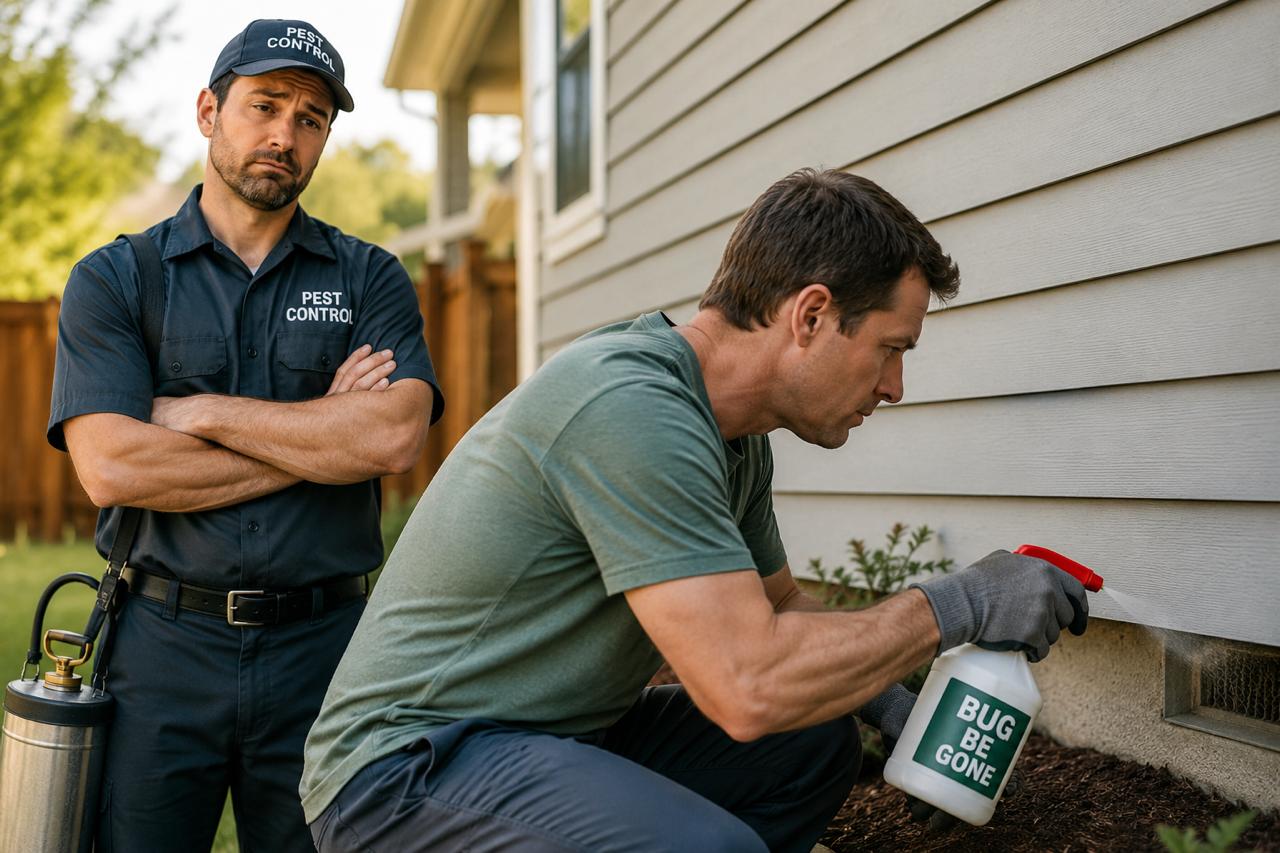
How DIY shows up on pest-control calls — and why the agents who engage it don't lose the sale
A pest-control agent, mid-call, hears the customer describe the traps they bought at Home Depot. Conventional sales instinct says: don't validate the do-it-yourself route — it competes with the service you're selling. Talk about DIY, the worry goes, and you talk yourself out of the sale.
We tested that worry against real calls from across our customer base — tens of thousands of conversations. We verified every DIY mention in its actual context (so that an agent describing the company's own bait stations or perimeter spray, for example, didn't get mistaken for a customer's home remedy). What emerged is a clear picture of customers describing their own attempts — the sprays they bought, the traps they set, the vinegar they poured — and agents deciding, in the moment, whether and how to engage.
Here's what the data showed: the agents who engage DIY don't forfeit the sale. More often than not, DIY — especially failed DIY — is the very thing that converts.
DIY is rarer than you'd think — and it's mostly the sound of DIY failing
DIY comes up on only about 4% of calls. But when it does, the picture is lopsided:
| What the DIY moment is | Share of DIY moments |
|---|---|
| Customer tried DIY and it failed | 66% |
| Customer floating a future DIY plan | 13% |
| Agent explaining why DIY won't work | 11% |
| Agent recommending a DIY step | 8% |
| Customer asking for DIY advice | 2% |
Two-thirds of all DIY conversation is a customer who already bought the spray, set the traps, poured the vinegar — and is calling because it didn't take care of the pest problem. DIY on these calls is overwhelmingly a past-tense story of a problem the customer couldn't solve on their own, not a live alternative they're weighing against your service.
The customer who tried and failed is your best caller
To measure what that failed attempt is worth, we tie each call to whether it ended in a booking and compare against the baseline (i.e., calls where DIY never comes up):
| Group | Booking rate vs. baseline |
|---|---|
| All calls where DIY comes up | +57% |
| Customer tried DIY and it failed | +71% |
| Customer floating a future DIY plan | +28% |
| Customer asking for DIY advice | at baseline |
A call that mentions DIY books at a 57% higher rate than one that doesn't. And the highest-converting group of all is the customer who already tried and failed — booking at more than 70% above baseline. That customer isn't lost to the hardware store. They're pre-qualified, arriving at exactly the moment they've conceded the job is bigger than they are.
Agents who engage DIY book above baseline — not below it
If talking about DIY cost sales, the calls where the agent raises it should book below baseline. Our customers' data tells the opposite story:
| Agent behavior | Booking rate vs. baseline |
|---|---|
| Agent engaged DIY (explained or recommended) | +36% |
| Agent explains why DIY won't work | +40% |
| Agent recommends a DIY step | +25% |
Every one of these books above baseline — including the calls where the agent actively recommends a DIY step. (Often that's an agent pointing a customer to a $10 fix for a problem too small for a truck roll. That call may not book today, but it's the kind of honesty customers remember when the problem gets bigger.)
The urban myth of the "forfeited sale" simply doesn't show up in the data. What we see instead is a set of conversational techniques — "moves" — that the best agents make.
Here's what they sound like in actual calls.
What engaging DIY sounds like when it works
Ask about it — then normalize the failure. The strongest openings don't wait for the customer to confess. The agent asks, and the story comes pouring out:
Agent: "So did you try to do DIY treatment?"
Customer: "I sprayed around the outside of the house with something I got at Home Depot… in the last three days we've killed over 200 ants… they've come back with a freaking army… we've been spraying everywhere with this Raid… I'm kinda just at wit's end."
Agent: "That's actually something we hear quite often. Sometimes clients try to do DIY treatments…"
That call booked and paid on the spot: a one-time ant treatment with a 45-day warranty, scheduled for the next morning. The DIY question didn't compete with the sale — it set it up. The customer got to tell the whole story of the failed battle with the army of ants, and "we hear this all the time" turned embarrassment into common ground.
Give the expertise away. In this next conversation, the agent repeatedly steers the customer away from bug-bombing — even conceding the customer could take that advice to a competitor:
Agent: "So we wanna flush. We don't wanna bomb."
Customer (turning to someone with him on the call): "Grateful you taught me something… She [the agent] just told me we should not bomb — please don't have them bomb, even if they could go to another company. It'll go into their other floors."
That call booked a two-stage service at $395. Free expertise bought trust, and trust booked the job. Notice the customer's own words: the moment the agent taught them something, the conversation stopped being a price comparison.
Validate what actually works, then differentiate. A customer describes buying "a billion stakes" at Walmart and Home Depot. The agent agrees they work rather than trashing them:
Customer: "Those stakes work really well… those are good DIY products."
Agent: "Yeah, those are good DIY products… it would only help. But when the pros go out, they make the proper recommendations… the good thing is you don't have to waste products anymore."
That call booked a premium recurring plan bundled with mosquito and tick service. Honest credit for what DIY can do is exactly what made the differentiation credible — the agent wasn't dismissing the customer's judgment, just showing where DIY reaches its limits.
And the return-after-failure pattern repeats across the calls, in the customers' own words:
"Every kind of mouse trap we could find…" → booked a mouse treatment plus a protection plan.
"I tried to control it on my own…" → booked an annual protection plan.
"I don't wanna keep spraying Raid…" → booked a one-time ant treatment at $325.
Take-away: lean in, don't dodge
DIY comes up on only about 4% of calls, and when it does, it's usually a customer who already tried and couldn't solve the problem on their own — and that's the highest-converting group of callers in the data, booking at roughly 70% above baseline. The instinct to steer clear of the topic isn't supported anywhere in customer-agent conversations. So, go ahead and ask about the DIY attempt with confidence and let the true story come out without fear of losing the deal. Normalize your caller's lack of success in trying to solve their problem using their own means, instead of judging it. Give real advice away, and give honest credit to what over-the-counter products can do before showing where professional service goes further. Agents who do this book above baseline, not below it — because engaging DIY isn't competing with your service. It's the consultative move that earns the right to sell it.