The Plan Is Won in Discovery, Not in the Price Argument
Every pest control company is built on recurring revenue. The typical customer who calls, though, is thinking about something narrower, a problem they assume is one-time. There are ants in the kitchen today; make them go away. The gap between what the business runs on and what the caller believes they're buying is where the first call from a prospective customer is quietly won or lost.
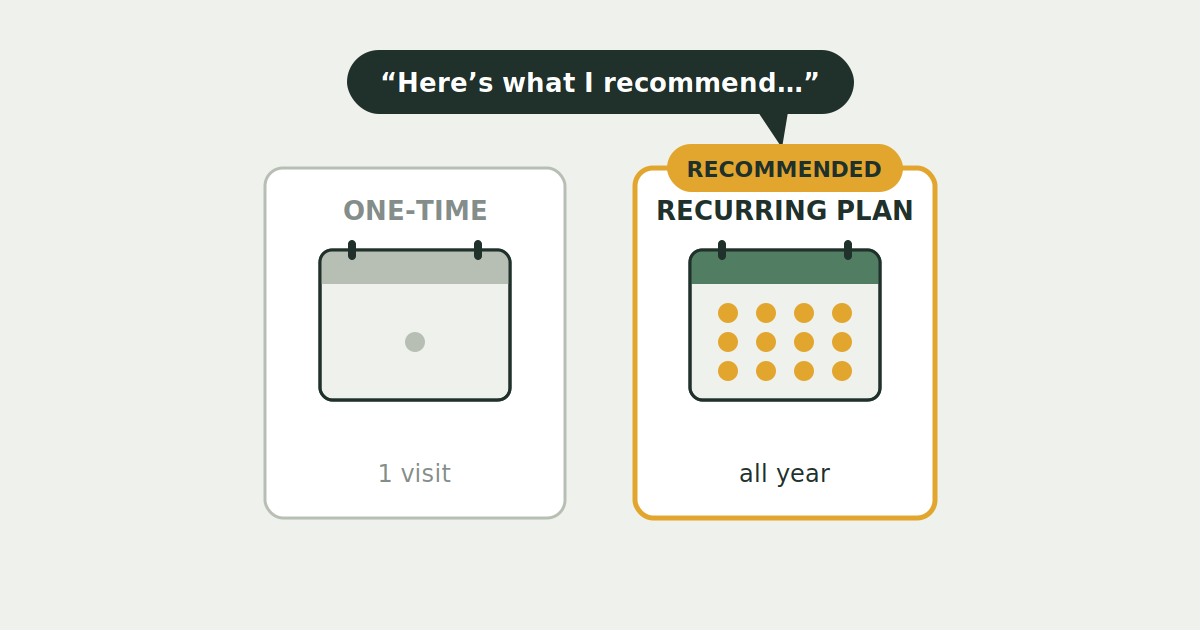
That same ant problem can usually be solved two ways: with a single one-time treatment, or with a recurring service plan. Both are real products the company sells, and in about one in four first inbound calls to a pest control company, both are genuinely on the table. The plan is the ongoing, repeat-revenue service operators build their businesses on; a one-time treatment is a single job that ends when the visit does. Whether a call like this ends with a plan or with a single treatment comes down to how the agent handles the conversation, and the most interesting thing we found is that the outcome hinges on when the agent brings up the plan.
We looked at first inbound calls across our customer base over the past three months and analyzed every call where a one-time treatment and a plan were both genuinely in play. The pattern that stood out had little to do with talking a customer out of a one-time request. In the calls that actually end with a plan, the customer usually never asks about a single treatment at all, because the agent has already made the case for the plan before the customer thought to ask for anything less.
Plans don't sell themselves
In an industry where retention is the number-one challenge, the plan does not sell itself. Left alone, a caller describing a pest problem simply asks to have the bug problem taken care of. Nobody phones in asking to be enrolled in a program. So it becomes the agent's responsibility to bring up the plan, and that is exactly what we saw in the anonymized customer calls we analyzed. In roughly two-thirds of these calls, the agent was the one who mentioned the plan first. Plans get sold because agents propose them.
How early in the call the agent brings up the plan matters just as much as whether they bring it up in the first place. The agent who leads, introducing the plan early as the natural solution to the problem the customer just described, never has to argue against a single treatment, because the discovery has already shown the customer that one visit won't put the problem to rest. On the other hand, the agent who waits finds that the customer has already decided what they want, and from then on every word is a negotiation.
What making the case for the plan sounds like
The approach that works best is discovery followed by a recommendation. The agent asks what's going on, then names the plan as the solution to that specific problem:
Agent: We could do a one-time treatment for you, that's one option. But based on what I'm hearing so far, I really do recommend doing our home protection plan, the second option, because based on what I've heard so far, you have a mice problem that's on and off, and you have an ant infestation. If you do the mice treatment one time, then after six months the mice return — you have to do a one-time treatment again. It's going to cost you more compared to doing a plan.
Notice what's happening here. The agent isn't hiding the single treatment; calling the plan "the second option" means both were laid out plainly. The difference from a neutral menu is that the agent listened first and then made a recommendation, and made the economics of the single visit explicit: paying for it twice costs about what a year on the plan does. By the time a customer hears that, "just a one-time" no longer sounds like the frugal option. When the discovery and the tailoring are this good, the request for a single visit rarely comes up at all. The option was never hidden. The customer can simply see that the plan is genuinely the better deal for their situation.
The one-time request is a symptom of waiting too long
Does leading with the plan actually pay off? By the time a customer asks "can you just come out once?", the call has usually already gone wrong. When we divided the calls between the ones where the agent recommended the plan first and the ones where the customer opened by asking for a single treatment, the pattern was stark.
When the agent did the discovery and recommended the plan on their own, and the customer never asked about a single treatment, the call was more than twice as likely to end with a plan as when the customer opened by asking for a one-time treatment and the agent had to work backward from there.
More telling still, of all the calls that ended with a plan, 88% were calls where the customer never asked about a single treatment to begin with. When that request does come up, it is mostly a sign that the agent waited too long to make the case for the plan. The best agents rarely have to argue against a single visit, because on their calls the request never comes up. By then, the discovery and the tailored recommendation have already shown the customer that the plan is the better choice for them.
When the customer asks for the one-time treatment anyway
Not every call unfolds that way. Sometimes the customer opens by asking for a single treatment (perhaps based on their own impression of what's needed), or the agent names both options early. Putting the single treatment on the table is not the mistake; it is honest. The mistake is what comes next: handing the two options over as equals and letting the customer choose, instead of making the case for the plan.
The most common thing agents did was lay out a neutral menu. Here is the one-time service, here is the plan, which would you like?
Agent: Do you want me to send over some information on our maintenance program?
Customer: No. Just the one time.
It feels even-handed, but offering the two options as equals mostly hands the customer the cheaper one. Across our customer base, the neutral menu rarely ended with a plan, and it almost never converted a caller who had asked for a single treatment into a plan customer. By contrast, agents who made the case for a plan booked plans roughly five times as often as the neutral menu did.
Which argument the agent made mattered too. By far the most effective was simple price arithmetic. When the agent showed that paying for two one-time treatments adds up to about the cost of a full year on the plan, callers who had asked for a single visit signed up for the plan roughly three times as often as with any other line of reasoning. Arguments about peace of mind and year-round coverage mostly persuaded customers who already wanted a plan, and rarely changed the mind of a caller focused on price. The lesson, which held across all our customers and the entire period of our research, was that when the customer's concern is money, the agent should answer with the numbers, not with reassurance. That is recipient design at work: the argument that converts is the one that answers what the customer signaled they care about. Lead with peace of mind for a caller who only ever talked about price, and it falls on deaf ears.
One more number puts this recovery in perspective. Even when the agent argued well and won, calls where the customer had already asked for a single treatment ended with a plan about as often as calls where the agent simply recommended the plan early, roughly one in four either way. In other words, the best rescue effort only brings the call back to where it would have started had the agent led with a recommendation. Arguing well is a useful backup skill. Leading with the recommendation makes it unnecessary.
Sometimes the one-time treatment is the right answer
Recommending the plan works only when the plan actually fits the customer's need. The same discovery that surfaces a recurring need also surfaces the cases where there isn't one, and the top-producing agents can identify those cases honestly. A caller with a single contained problem, a short-term rental, or a pest the plan doesn't cover has no need for a recurring program, and pushing one anyway is how the company loses the trust, and with it the call that would have come when the next pest problem shows up.
Agent: I wouldn't even suggest the recurring plan at all. It definitely sounds like you can benefit from our one-time service. If you were staying there for the next year, I would definitely suggest the plan.
In our data, about one call in sixteen was a genuine poor fit for a plan. When the agent recognized that and booked the one-time service instead of overselling a plan, it was the right product matched to the customer's problem, and a successful sale in its own right. More often, it was exactly what the company's own sales script, written by the owner or the head of inside sales, instructed the agent to do. Knowing when to recommend the plan, and when not to, is as much a part of the agent's skill as making the recommendation convincing.
The main lesson, played out in two calls
The clearest illustration of everything above came from a single agent, on two calls two days apart.
On the first call, a customer asked about general pest service. The agent skipped discovery and opened with the menu:
Agent: Are you looking for just, like, general pest preventative, or are you looking for, like, a one-time general?
The customer picked the one-time service, heard a price near four hundred dollars, and left to think about it. The call ended without a booking.
Two days later, after a coaching session that walked through that first call, the same agent picked up a customer who wanted a move-in treatment for roaches. This time the agent ran a real diagnostic, asking what species, where they'd been seen, and how bad the problem was, and only then made the case:
Agent: We do offer one-times. They're a little pricey. And if you spend on my one-time twice, you've pretty much paid for the whole year of my service.
The customer signed up for the plan before the call ended. Those two calls, side by side, are the crux of the matter. Presenting the menu lost a booking, while leading with a recommendation backed by real discovery opened a new account.
Take-away: lead by recommending the recurring service plan
The numbers point to one priority. Agents who recommended the plan on their own booked plans more than twice as often as agents who were reacting to a customer's request for a single treatment. So lead with the plan as the default recommendation when it fits the customer's situation. Ask about the problem first, then recommend the plan as the solution to the specific situation the customer described. When the problem really is one-and-done, say so and book the one-time service, because forcing a plan onto a poor fit costs the trust and the future business.
When both options are genuinely on the table, put them both there openly, and then steer toward the plan through the customer's benefit, not the company's. The arguments that move people are the ones grounded in their situation: the total cost over a year, and a problem that discovery says is likely to return. That is not a trick. It is an honest, expert consultation that helps the customer see the choice clearly.
Laying out the options is not the problem. Presenting them as equals is. A neutral menu quietly steers the customer toward the cheaper job, and once a caller has settled on a single treatment, even a skilled agent is climbing uphill. And the wrong fix, however cheap, leaves the customer worse off and unlikely to come back.
When the customer does ask for a one-time treatment, make a recommendation instead of reading out the menu, and lead with the price arithmetic. Price is the customer's own concern, so turn it into the reason to choose the plan. Two one-time treatments usually cost about as much as a year of service, and the plan comes with the guarantee.